 Tech with Patience
Is this text a scam? 5 signs to check before you tap
Scam texts pretend to be Canada Post, your bank or the government. Almost all of them share the same five signs. Here's how to spot them, and what to do instead of tapping.
Five signs a text is a scam
It rushes you
"Final notice." "Within 24 hours." "Your account will be locked." A real company gives you time. If a message makes your heart beat faster, slow down.
It came out of nowhere
Were you expecting it? Scammers can make a message look like it came from a real company, or even a number you know, so a familiar name isn't proof.
It wants you to tap a link
Read the link, but don't touch it. A real company name tucked inside a longer, strange address is a warning sign. Short links and odd endings are too.
It asks for money or private information
A small fee, your card number, a password, or a code sent to your phone. Canada Post says it will never text you asking for payment or banking information. Never share a code that was texted to you.
It's too good, or too scary, to be true
A surprise refund or prize, or an unpaid fine, frozen account or police warning. These messages play on hope, or on fear.
Read the full transcript
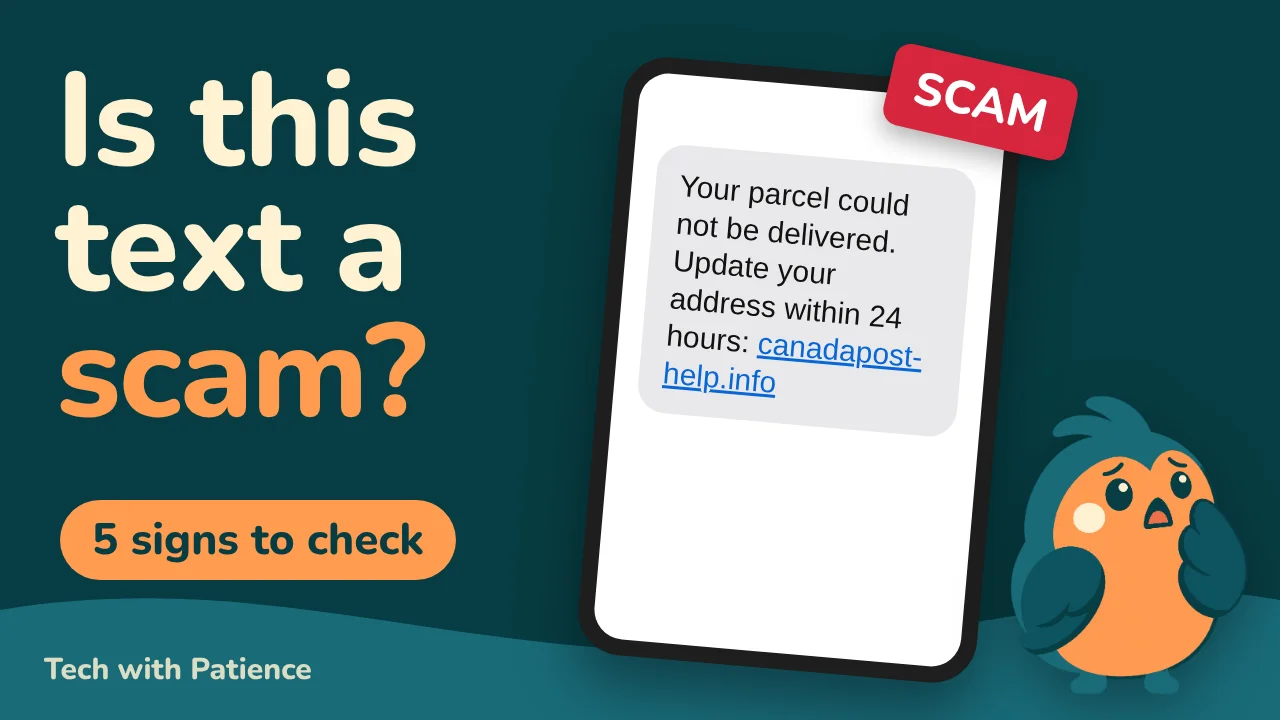
This text says your package couldn't be delivered. It looks real, but it's a scam. In the next few minutes, I'll show you five simple signs that give it away, so you'll know before you tap.
Welcome to Tech with Patience. We go slowly here, so there's no rush. If you need to, pause the video and look at the example on screen for as long as you like.
Scam texts are sometimes called smishing. That just means a fake text message that tries to trick you into tapping a link or sharing private information. They're very common in Canada right now. But almost all of them share the same five signs.
Sign number one: it rushes you. Look at these words. "Final notice." "Within 24 hours." "Your account will be locked." Scammers want you to act before you have time to think. A real company will give you time. So whenever a message makes your heart beat a little faster, that's your cue to slow down.
Sign number two: it came out of nowhere. Did you order something? Were you expecting this message? Scam texts often come from a number you don't know, or from an email address instead of a phone number. And here's the tricky part: scammers can make a message look like it came from a real company, or even a number you know. So a familiar name isn't proof. Ask yourself: was I expecting this?
Sign number three: it wants you to tap a link. You can read the link, but don't touch it. Look closely at this one. It mentions Canada Post, but it isn't Canada Post's real website. The real name is tucked inside a longer, strange address. Short links and odd endings are warning signs too. The safest rule is simple: if you weren't expecting the message, don't tap the link at all.
Sign number four: it asks for money or private information. This could be a small fee, maybe two dollars, to redeliver a package. Or your card number. Or a password. Or a code that was just sent to your phone. Canada Post says it will never text you asking for payment for a delivery, or for your banking information. The Canada Revenue Agency says it will never ask you to pay with gift cards, bitcoin or e-Transfer. And never share a code that was texted to you. Not with anyone.
Sign number five: it's too good, or too scary, to be true. A tax refund waiting for you. A prize you never entered. Or the opposite: an unpaid fine, a frozen bank account, or a warning about the police. These messages play on hope, or on fear. That's how you know to stop and check.
Let's go over them one more time. One: it rushes you. Two: it came out of nowhere. Three: it wants you to tap a link. Four: it asks for money or private information. Five: it's too good, or too scary, to be true. Even one of these signs is enough to stop and check.
So what should you do when you get one? First, don't tap the link, and don't reply. Not even with "STOP." Replying tells the scammer your number is real. Second, if you're worried it might be real, check for yourself. Call the company using the number on your card, your bill or their official website. Never a number from the text. Third, report it. Forward the text to 7726. That spells SPAM on your keypad. It's free, and it helps phone companies block these messages for everyone. Then delete the message and block the number.
And if you already tapped, or shared information, don't be embarrassed. It happens to careful people every day. Call your bank right away, using the number on the back of your card. Then report it to the Canadian Anti-Fraud Centre. Their website and phone number are in the description below.
That's it. Slow down, check the five signs, and you'll catch almost every scam text. If this helped, share it with someone you love. Scammers count on people not knowing these signs. Next time, we'll look at fake virus warnings that pop up on your computer. Take care.